
Employment Application Apply
Wastewater pressure is reshaping China’s industrial water-treatment market. The 2024 United Nations World Water Development Report identifies water quality, reuse, and resilient infrastructure as urgent global priorities. UN-Water also reports that a large share of wastewater still enters the environment without adequate treatment. These findings make the Waste Water Ro System more than a filtration product. It is a practical tool for reducing dissolved salts, protecting production lines, and recovering usable process water.
Industry data supports this direction. The International Desalination Association’s market reviews show continuing investment in desalination and membrane-based treatment. Grand View Research also identifies reverse osmosis as a major technology within the expanding water-treatment equipment market. However, market figures differ by definition, region, and application. A top-ten list can still mislead.
Professor Menachem Elimelech, a leading membrane science researcher, has repeatedly stressed that “the global water crisis is fundamentally a water-quality crisis.” His point remains highly relevant to industrial wastewater. A reliable Waste Water RO System must match feed-water chemistry, recovery targets, pretreatment quality, and concentrate-management requirements.
This introduction examines ten leading Chinese manufacturers through those practical criteria. It considers engineering experience, membrane performance, automation, after-sales support, certifications, and project evidence. Factory photographs are not enough. Neither are impressive recovery claims.
Real performance appears in operating details: stable pressure, lower fouling, consistent permeate quality, and manageable cleaning intervals. Some suppliers publish limited field data. That deserves scrutiny. The strongest manufacturers combine documented installations with transparent technical support and realistic operating expectations.
What Is a Wastewater RO System?
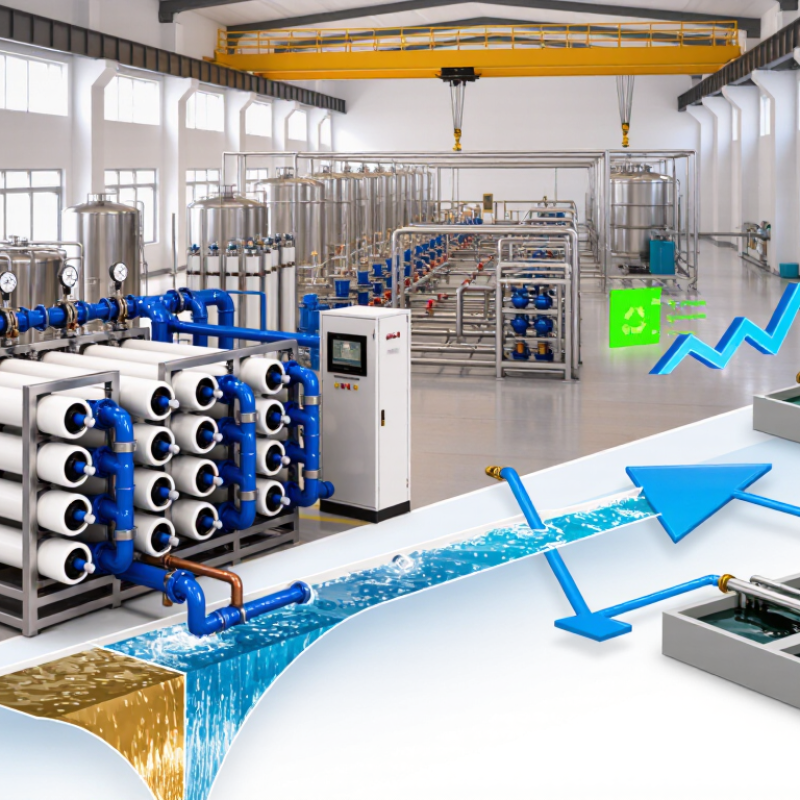
A wastewater reverse osmosis system treats contaminated water through semi-permeable membranes. Pressure pushes water through pores near 0.0001 microns wide. Dissolved salts, metals, microbes, and many organic compounds remain in the concentrate stream. Pretreatment usually includes screening, filtration, pH control, and antiscalant dosing. Without it, membranes can foul quickly, especially when oily water or suspended solids enter the system.
The need is substantial. The WHO and UNICEF Joint Monitoring Programme reported in 2023 that 2.2 billion people lacked safely managed drinking water. The United Nations World Water Development Report 2024 also links water stress with rising industrial and urban demand. In practical operations, RO recovery often ranges from 50% to 85%, depending on feed quality and design. A 100-cubic-meter input may therefore produce 50 to 85 cubic meters of permeate. The rest needs controlled handling.
Permeate quality depends on membrane selection, pressure, temperature, and maintenance. Conductivity meters show performance in real time. Operators also inspect differential pressure and clean membranes when normalized flow declines. A system can look efficient while wasting too much water through poor recovery settings. That detail is often overlooked. RO is not a complete treatment answer; it needs upstream biological or chemical treatment when wastewater contains high organic loads. Site testing remains essential, because laboratory water rarely behaves like wastewater from a busy plant.
Wastewater reverse osmosis systems in China treat water through several controlled stages. Operators usually begin with screening, sediment removal, and chemical conditioning. These steps protect the membrane from fibers, oil, hardness, and biological growth. The details matter.
A high-pressure pump then pushes pretreated water across semi-permeable membranes. Water molecules pass through, while many dissolved salts, metals, and organic compounds remain behind. The purified stream is called permeate. The concentrated stream is called reject water. RO does not destroy pollutants. It separates them, so reject handling requires careful planning and lawful disposal.
In an operating room, a conductivity meter can show membrane performance within seconds. Pressure gauges reveal clogging or poor pretreatment. Technicians also check flow, temperature, pH, and recovery rate. In many Chinese factories, wastewater quality changes sharply between production shifts. A system designed from one laboratory sample may perform poorly later. That is an important weakness.
Membrane cleaning is not simply a routine chemical wash. The method must match the fouling type and membrane material. Excessive cleaning can shorten membrane life. Insufficient cleaning raises energy use and lowers output. Experienced engineers record pressure differences, cleaning dates, and water results. They adjust settings gradually, rather than trusting automatic controls completely. Small operating errors can become expensive.
China Top 10 Waste Water RO System Manufacturers
Key Criteria for Selecting Chinese RO Manufacturers
Selection should begin with verified process data, not a polished catalog. The WHO and UNICEF Joint Monitoring Programme reported that 2.2 billion people lacked safely managed drinking water in 2022. Industrial reuse therefore demands dependable treatment, not simply high membrane pressure. Ask manufacturers for normalized permeate flow, salt rejection, recovery rate, energy consumption, and chemical-cleaning records from comparable wastewater.
Pretreatment is often the deciding factor. Request laboratory analysis for COD, oil, hardness, silica, suspended solids, and biological activity. Then check whether the proposed system includes clarification, filtration, antiscalant control, and cartridge protection. The 2024 UN World Water Development Report emphasizes rising water stress and stronger pressure on industrial efficiency. A system that ignores fouling risks may perform well during commissioning, then deteriorate quietly.
Look beyond the lowest quotation. Require a pilot test using your actual wastewater, with raw-data access and clear acceptance criteria. Review membrane replacement intervals, instrument calibration, spare-part availability, operator training, and remote troubleshooting. ISO 9001 certification can support process consistency, but it does not prove treatment performance. Inspect the workshop, welding quality, electrical panels, and factory testing when possible. No checklist is perfect. I would still question unusually optimistic recovery claims, especially when the supplier avoids a long-term performance guarantee.
China’s Top 10 Wastewater RO System Manufacturers should be judged by engineering evidence, not factory size alone. A credible review should examine recovery rate, salt rejection, energy use, membrane protection, and after-sales support. The China Urban-Rural Construction Statistical Yearbook reports that urban sewage treatment rates have exceeded 98%, yet treatment quality varies by region and application. That gap creates demand for reliable reverse osmosis systems.
Performance matters in the field. The International Desalination Association identifies energy efficiency as a central issue in membrane treatment, especially when feedwater contains high dissolved solids. Practical systems often require pretreatment, cartridge filtration, antiscalant dosing, and regular cleaning. One weak stage can shorten membrane life. Simple.
A useful top-ten evaluation should also compare documented pilot results, design capacity, operating pressure, and wastewater reuse records. The UN World Water Development Report highlights continuing global pressure on freshwater resources, while industrial water reuse is becoming more important. However, published figures may describe ideal conditions. They can overlook seasonal wastewater changes, operator skill, and maintenance delays. That is where a ranking becomes imperfect. Buyers should request test data from comparable wastewater, not only laboratory certificates. A manufacturer with transparent limitations may deserve more trust than one promising flawless recovery.
| Rank | Anonymous Manufacturer Profile | Primary Wastewater Applications | Typical RO Configuration | Indicative Capacity Range | Typical Recovery Rate | Feedwater TDS Suitability | Automation Level | Common Compliance References |
|---|---|---|---|---|---|---|---|---|
| 1 | Large integrated water-treatment manufacturer | Municipal reuse, industrial effluent polishing, process-water production | Two-stage brackish-water RO with multimedia and cartridge pretreatment | 10–1,000 m³/day | 65–80% | Up to approximately 5,000 mg/L | PLC control, online conductivity and pressure monitoring | ISO 9001; project-specific CE and electrical requirements |
| 2 | Industrial water-reuse system specialist | Textile, food-processing, electronics and general manufacturing wastewater | Single- or two-pass RO with ultrafiltration pretreatment | 20–800 m³/day | 60–80% | Approximately 1,000–4,000 mg/L | PLC-based automatic flushing and chemical dosing | ISO 9001; applicable local discharge and reuse standards |
| 3 | Containerized wastewater-treatment manufacturer | Remote factories, construction sites, temporary reuse and decentralized treatment | Compact containerized RO with sediment, carbon and cartridge filtration | 5–300 m³/day | 55–75% | Up to approximately 3,500 mg/L | Automatic start/stop, alarm protection and remote-ready controls | ISO 9001; container and electrical safety requirements |
| 4 | Membrane-process engineering manufacturer | High-quality reuse water, boiler feed and industrial process water | MBR or UF pretreatment followed by two-pass RO and polishing | 50–2,000 m³/day | 70–85% | Approximately 500–3,000 mg/L | Advanced PLC or SCADA integration with data logging | ISO 9001; application-specific water-quality specifications |
| 5 | Commercial and light-industrial RO manufacturer | Hotels, hospitals, laboratories, food plants and small factories | Single-pass brackish-water RO with cartridge filtration | 2–150 m³/day | 50–75% | Up to approximately 2,500 mg/L | Automatic conductivity control and low-pressure shutdown | ISO 9001; component-level CE documentation where applicable |
| 6 | Custom-engineered industrial treatment manufacturer | Chemical, pharmaceutical, metal-finishing and power-sector wastewater | Custom pretreatment, brackish-water RO and concentrate-management package | 30–1,500 m³/day | 60–82% | Approximately 1,000–6,000 mg/L after pretreatment | PLC, SCADA, interlocks and online quality instruments | ISO 9001; project-specific engineering and safety standards |
| 7 | Modular water-recycling equipment manufacturer | Process-water recycling, cooling-tower makeup and wash-water recovery | Modular RO skids with optional ultrafiltration and softening | 10–600 m³/day | 60–78% | Up to approximately 4,000 mg/L | Automatic membrane flushing, alarms and touchscreen HMI | ISO 9001; customer and destination-market requirements |
| 8 | Municipal and environmental-equipment manufacturer | Landfill leachate polishing, municipal reuse and wastewater reclamation | High-pressure RO with robust pretreatment and concentrate handling | 50–3,000 m³/day | 50–75% | Feedwater-dependent; often requires staged pretreatment | Centralized PLC or SCADA with remote monitoring options | ISO 9001; local environmental permitting and discharge standards |
| 9 | Small-footprint packaged-system manufacturer | Restaurants, workshops, small factories and decentralized reuse projects | Compact single-pass RO with multimedia and cartridge filtration | 1–80 m³/day | 45–70% | Up to approximately 2,000 mg/L | Basic automatic operation with protection alarms | ISO 9001; standard electrical and pressure-equipment requirements |
| 10 | Export-oriented water-treatment equipment manufacturer | Overseas industrial projects, packaged reuse systems and OEM installations | Configurable RO skid with optional UF, softening and UV polishing | 5–1,000 m³/day | 55–80% | Approximately 500–5,000 mg/L, depending on pretreatment | PLC control with multilingual HMI and remote-service capability | ISO 9001; CE or destination-market documentation where required |
Note: Capacity, recovery and feedwater values are indicative engineering ranges. Actual performance depends on wastewater composition, pretreatment design, membrane selection, operating temperature and local compliance requirements.
Comparing the top ten wastewater RO manufacturers requires more than checking flow rates and prices. Product quality begins with pretreatment. Multimedia filters, cartridge filters, and reliable dosing systems protect membranes from fouling. A practical system should also show recovery rate, salt rejection, design flux, and cleaning frequency. These details matter beside a factory floor, where high turbidity can change within hours.
Technology differences become clearer during operation. Some manufacturers provide energy recovery, automatic CIP, online conductivity monitoring, and PLC alarms. Others offer simpler skids with lower purchase costs. Seawater RO commonly requires about 2.5–4.0 kWh per cubic metre, according to International Desalination Association industry data. Wastewater RO can consume less, but feed quality determines the result. Buyers should request pilot-test records, membrane replacement assumptions, and actual rejection data. Laboratory figures are not always field figures. That is an uncomfortable gap.
After-sales service often separates a good supplier from a difficult one. Compare commissioning support, technician response time, spare-parts storage, training, and warranty exclusions. Remote monitoring helps, but it cannot replace a skilled local engineer. A useful contract should define response within 24 or 48 hours. It should also identify who pays for membrane damage caused by pretreatment failure.
My comparison would not be flawless without site data. A cheaper system may win on paper and lose after six months.