Top 10 Wood Drying Equipment Manufacturers to Consider?
Choosing the right Wood Drying Equipment can determine whether timber leaves the kiln stable, marketable, and ready for demanding applications. Moisture content, wood species, board thickness, energy use, airflow, and control accuracy all influence the result. A beautiful kiln exterior means little if the center of a thick oak board remains wet.
Dr. Michael Milota, a respected wood-drying researcher, has often stressed the importance of process control: “Drying wood is not simply removing moisture; it is controlling stress.” That principle guides this review of the Top 10 Wood Drying Equipment Manufacturers to Consider. The strongest manufacturers do more than sell chambers, fans, or sensors. They provide drying schedules, technical support, maintenance guidance, and measurable performance data.
Details matter.
A poorly placed temperature sensor can distort the entire cycle. Uneven airflow may leave pale surfaces and dark, case-hardened cores. Energy consumption can also rise quietly, especially in older steam or conventional systems. These issues are easy to overlook during a factory visit.
This guide compares manufacturers through practical criteria, including kiln design, automation, heat-source compatibility, capacity, after-sales service, and suitability for different production scales. Some rankings may remain debatable because regional support and species requirements vary. That is worth admitting. A small furniture workshop may value flexibility more than maximum throughput, while a large sawmill may prioritize uptime, data logging, and recovery speed. The best choice is not always the most expensive one. It is the system that consistently produces dry, stable timber under real operating conditions.
What Wood Drying Equipment Does and How It Works
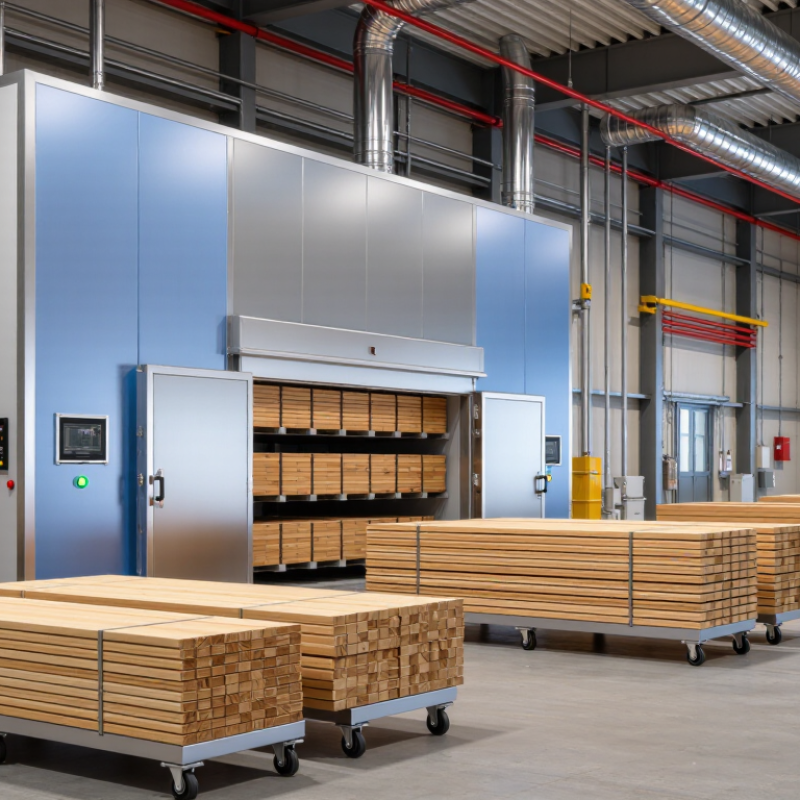
Wood drying equipment removes excess moisture from lumber under controlled conditions. It helps reduce warping, checking, and uneven shrinkage before wood is used in furniture or construction. A typical kiln combines an insulated chamber, heaters, circulation fans, vents, and sensors. Some systems also use dehumidifiers to collect moisture from the air. It takes patience.
Inside the chamber, warm air moves across stacked boards, while spacers leave narrow channels for airflow. Heat encourages water inside the wood to migrate toward the surface. Moving air carries that moisture away, and vents or dehumidification equipment manage the damp air. Operators adjust temperature and humidity gradually, following a drying schedule suited to the wood species and board thickness. Thin boards usually dry faster than thick ones, but the exact time varies.
Moisture meters help track progress, though readings can differ by location and wood condition. Checking several boards is more dependable than relying on one measurement. Kiln operators also watch for surface checks, case hardening, and uneven drying. A schedule that works for one load may not suit another; that is easy to underestimate. Good equipment supports careful control, but it cannot replace sound stacking, regular inspection, and informed adjustments.
Key Criteria for Evaluating Wood Drying Equipment Manufacturers
Key Criteria for Evaluating Wood Drying Equipment Manufacturers
Choosing a wood-drying equipment manufacturer starts with the lumber you actually process. Ask how the proposed system handles your species, board thickness, stack dimensions, and target moisture range. A kiln designed for thin softwood may perform differently with dense hardwood. Request test data from comparable loads, not just maximum-capacity figures. Even drying matters. Check how the design manages airflow across the stack, where moisture sensors sit, and how operators verify readings.
Look closely at controls, energy use, and service support. Can the control system record temperature and humidity throughout a cycle? Ask how often sensors need calibration and whether replacement parts are readily available. Get operating-cost estimates based on your local energy source and normal production schedule. A polished brochure can hide assumptions, so ask what the quoted figures include. Speak with existing users about drying consistency, downtime, and response times. The answers may be less tidy than a sales presentation, but more useful.
Tips: Share a real load profile before comparing quotes. Ask for a sample drying schedule and a written service plan. Visit an operating site if possible. Check the details, not only the promises.
Top 10 Wood Drying Equipment Manufacturers to Consider
Choosing among the top 10 wood drying equipment manufacturers starts with the lumber, not the brochure. A kiln suited to thin pine may struggle with thick hardwood. Ask manufacturers to explain how their systems handle your species, board thickness, starting moisture, and target moisture content. Request operating data from comparable installations, not just rated capacity. Real-world conditions matter.
A useful shortlist can include manufacturers of conventional kilns, dehumidification systems, vacuum dryers, radio-frequency units, solar-assisted kilns, batch chambers, continuous dryers, modular systems, control upgrades, and retrofit equipment. These categories serve different production needs; they are not a quality ranking. Compare airflow uniformity, temperature control, sensor placement, energy use, and maintenance access. Look for clear commissioning plans and operator training. Ask what happens when a sensor fails. Small details count.
Check whether service technicians can reach your site and whether replacement parts are readily available. Request references from mills drying similar wood, then ask about actual cycle times and defects. A ranking can mislead. I would also inspect the chamber doors, seals, fans, and data logs in person, if possible. No system removes every risk: uneven stacking or poor moisture readings can still cause checking, warping, or wasted energy. Manufacturers should discuss those limits plainly.
How Leading Manufacturers Differ in Technology and Services
When comparing leading wood-drying equipment manufacturers, look beyond advertised capacity. Their real differences appear in moisture sensing, airflow control, heat recovery, and how precisely schedules can be adjusted for species and board thickness. The USDA Forest Service’s Wood Handbook (FPL-GTR-282, 2021) reports equilibrium moisture contents of about 6.9% at 70°F and 35% relative humidity, and 9.2% at 50% relative humidity. Small climate shifts matter.
Conventional kilns suit many steady, high-volume operations; dehumidification systems can recover heat, while vacuum systems may shorten cycles for selected products. These methods are not interchangeable. A supplier should explain expected drying times, energy use, moisture variation, and handling limits using your actual lumber mix. Ask for trial data, not just a polished demonstration. Details matter.
Service can separate similar-looking machines. Strong providers help with kiln layout, commissioning, sensor calibration, operator training, and replacement parts. Ask how they diagnose wet pockets or casehardening, and whether remote monitoring is backed by local technicians. Request references from mills processing comparable species and dimensions. One caution: projected savings often depend on loading and operating discipline. I would treat a forecast as a testable estimate, not a promise.
How Wood-Drying Technologies Differ
Typical operating temperatures vary by system design, wood species, and drying schedule. These ranges compare technology types, not individual manufacturers or product specifications.
How to Match a Manufacturer to Your Production Needs
Matching a wood-drying equipment manufacturer starts with the lumber, not the machine. List your species, thickness range, daily volume, and target moisture content. A shop drying 25-millimeter boards needs different airflow and loading flexibility from a mill handling thick beams. Small details matter. Ask how the proposed system handles uneven loads and seasonal changes, not just its advertised maximum capacity.
The USDA Forest Products Laboratory’s Wood Handbook (FPL-GTR-282, 2021) reports equilibrium moisture contents of about 6.2% at 30% relative humidity and 9.2% at 50%, at 70°F. These figures show why control range matters: the right drying schedule depends on the wood and its intended environment. Ask manufacturers for cycle data on comparable species and dimensions. Request details on sensor placement, airflow uniformity, energy use, and how operators verify moisture readings. A low quoted cycle time is not persuasive without those conditions.
Evaluate the whole operating setup. Will the kiln fit your loading equipment, floor space, and power supply? Can the controls store recipes and flag sensor faults? Ask for references from facilities with similar production patterns, plus a clear plan for installation, training, and spare parts. If possible, inspect a running system and compare measured board moisture with its control display. I would avoid choosing on purchase price alone. Yet I might also resist paying for automation that the crew will not use. That judgment takes time.