What Is the Best China PE Filler Masterbatch?
Choosing the best Pe Filler Masterbatch is not a simple price comparison. It is a material and processing decision.
Dr. Chris DeArmitt, a plastics materials expert, offers a useful principle: “A filler should be chosen for performance, not price alone.” That idea matters on a production floor. A low-cost masterbatch may appear attractive beside stacked resin bags. Yet poor dispersion can create white specks, weak seams, unstable film thickness, or blocked screens.
The right Pe Filler Masterbatch depends on the final product and processing method. Film manufacturers may prioritize calcium carbonate dispersion, melt flow, and surface smoothness. Injection molders may focus on stiffness, shrinkage control, cycle time, and part appearance. The carrier resin should also match the base polyethylene. A mismatch can cause feeding problems and uneven filler distribution.
Useful checks include calcium carbonate purity, particle size, moisture level, additive compatibility, and recommended dosage. Requesting technical data is sensible. Testing a small production batch is better. Laboratory results do not always predict behavior inside a busy extruder.
There is no universal “best” product. That answer sounds convenient, but it is incomplete. A formulation that performs well in blown film may fail in thin-wall injection molding. Even excellent masterbatch can underperform when storage conditions are poor or mixing is insufficient.
This guide compares the practical factors behind reliable Pe Filler Masterbatch selection. It considers quality, processing stability, application results, and supplier support. The goal is not to promise perfection. It is to help buyers make a defensible choice with clearer evidence.
PE Filler Masterbatch: Definition and 70–85% Calcium Carbonate Loading
What Is the Best China PE Filler Masterbatch?
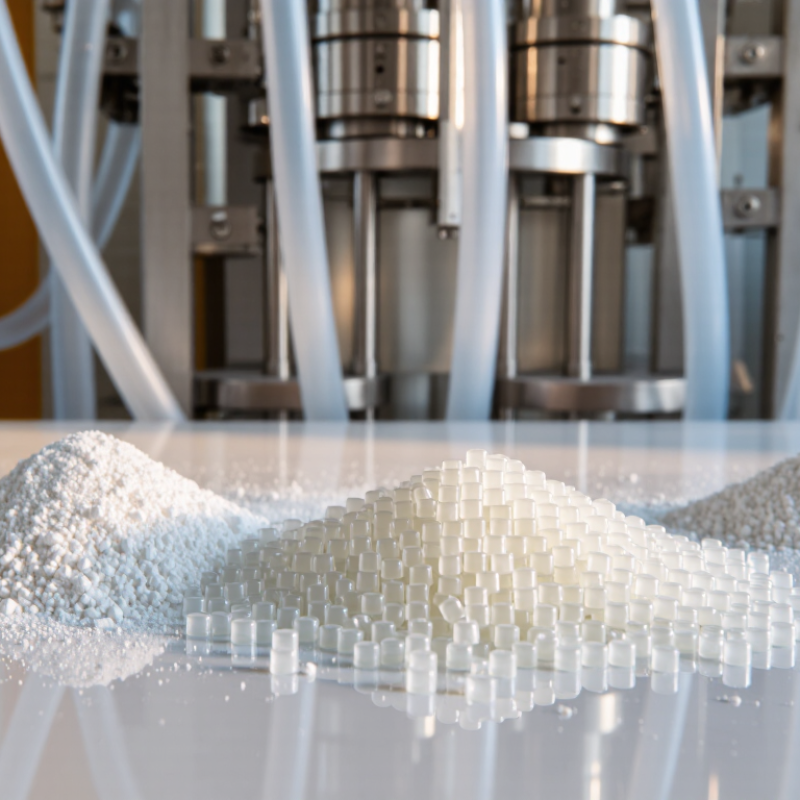
PE filler masterbatch is a concentrated additive for introducing calcium carbonate into polyethylene products. It combines calcium carbonate with a PE carrier and processing aids. In practice, it appears as small, uniform pellets. These pellets disperse through films, bags, sheets, pipes, or molded parts during melting. A 70–85% calcium carbonate loading means the masterbatch contains approximately 70–85% mineral by weight. The remaining material supports flow, bonding, and dispersion. Not every application needs the highest loading.
At 70%, the compound usually offers easier feeding and more carrier resin. At 85%, it can reduce resin consumption more aggressively. However, processing becomes less forgiving. Poor dispersion may create white specks, brittle zones, die buildup, or uneven thickness. Moisture matters. Particle size, surface treatment, screw design, and dosing accuracy also affect results. A clean-looking pellet can still fail during a long film run. A short laboratory trial cannot fully predict twelve-hour production behavior.
When comparing Chinese suppliers, request calcium carbonate content, carrier type, melt flow rate, moisture, ash, and dosage guidance. Ask for batch records and samples from separate lots. Test the material with your actual polyethylene grade, not only standard film. Check tensile strength, elongation, opacity, surface finish, sealing performance, and filter pressure. The highest mineral percentage is not automatically the best choice. Record unexpected results carefully, because one formula may perform differently after temperature, speed, or humidity changes.
PE Filler Masterbatch: Typical Calcium Carbonate Loading
PE filler masterbatch commonly contains 70–85% calcium carbonate by weight. The remaining formulation balance consists mainly of a polyethylene carrier resin and processing additives. Higher mineral loading can improve cost efficiency, but the appropriate level depends on dispersion, melt flow, mechanical performance, and the end-use application.
How 1–3 μm CaCO₃ Particle Size Influences Dispersion and Film Quality
What Is the Best China PE Filler Masterbatch?
For PE film, 1–3 μm calcium carbonate particles can strongly influence dispersion and surface appearance. Smaller particles provide a larger surface area, helping create a more even filler distribution when processing conditions are suitable. Particle size matters. Poorly dispersed powder may form visible gels, pinholes, or weak spots in the film. These defects often appear as cloudy streaks under transmitted light.
In production trials, I examine particle distribution through microscopy, melt flow behavior, and actual blown-film samples. A 1 μm grade may improve opacity and thickness consistency, but it can also increase compound viscosity and demand better surface treatment. A 3 μm grade may process more easily, yet it can produce rougher surfaces if agglomerates remain. The carrier resin, mixing energy, screw design, and filler loading all change the result. Size alone is not enough.
Film quality must be judged beyond appearance. I check haze, tensile strength, elongation, puncture resistance, and die build-up after continuous running. Moisture control also matters, especially when storage conditions are inconsistent. In my experience, a theoretically finer powder does not always deliver a better film. That assumption needs testing. Small agglomerates can survive extrusion when shear is too low or feeding is unstable. A practical evaluation compares several 1–3 μm distributions at equal loading, using the same PE grade and extrusion settings. Measure it. Then adjust the formulation according to the film’s actual behavior.
Evaluating 10–30% Masterbatch Addition in PE Processing and Cost Control
Choosing the best China PE filler masterbatch requires more than comparing the lowest price per kilogram. The addition level changes processing behavior, product performance, and real material savings. In practical trials, 10% loading often offers smoother dispersion and limited changes to tensile strength. A 20% addition can reduce resin consumption more noticeably, but melt flow and impact strength need checking. At 30%, cost benefits may increase, while surface defects or brittleness can appear.
Run controlled trials on the actual PE grade and equipment. Record melt pressure, screw torque, output, and die temperature. Inspect film haze, molded surfaces, and cut edges under consistent lighting. A filler masterbatch with stable calcium carbonate dispersion can reduce agglomerates and processing fluctuations. Particle size, carrier compatibility, moisture, and calcium carbonate content all influence results. Small differences matter.
Cost control should use the final product cost, not the masterbatch price alone. Calculate resin replacement, energy use, rejected parts, and cycle time. A cheaper formula may create more waste. That is not savings. In my experience, 20% is a useful starting point, but it is not a universal answer. Some applications perform better near 10%; rigid profiles may tolerate 30% with proper formulation. I would still question any supplier data without batch records, laboratory results, and production samples. A trial may look successful for one shift, yet fail after continuous processing. Validation needs repeated runs, especially when appearance and impact resistance are critical.
Selecting Suppliers Through ISO 9001, Batch Data, and Application Trials
Choosing the best China PE filler masterbatch requires more than comparing prices. A supplier’s ISO 9001 certificate is a useful starting point, not final evidence. Check its scope, issuing body, validity, and covered production site. Ask how complaints, nonconforming batches, and corrective actions are recorded. Not enough. A certificate cannot replace process discipline. Visit when possible, and observe pellet storage, weighing controls, and dust management. These details reveal consistency better than polished sales language.
Request batch-level data, not a single laboratory report. Review calcium carbonate content, carrier-resin grade, moisture, ash, particle-size distribution, melt flow rate, and color. Compare at least three recent batches. Small variations may change film stiffness, surface finish, or die pressure. The report should show test methods, dates, lot numbers, and acceptance limits. Ask for retained samples. Then test them independently. Sourcing decisions often lean too heavily on one attractive data sheet. That shortcut creates avoidable doubt.
Application trials should use your actual PE grade, equipment, and target loading. Run a controlled comparison at identical temperatures and screw settings. Measure tensile strength, elongation, opacity, dispersion, filter pressure, and output stability. For blown film, inspect gels and gauge variation after steady production. For injection molding, check warpage, impact, and cycle behavior. Record results from startup, not only ideal samples. A supplier willing to adjust formulation deserves attention, but every change needs a new lot and trial. Some evaluations fail because operators change several variables at once. Keep the trial imperfect but traceable. That is where reliable decisions begin.