| Evaporator Type |
Rising-film evaporator |
Vertical long-tube design with vapor-driven liquid circulation |
Feed solids commonly below 10–15% before evaporation |
Low-viscosity liquids that are relatively resistant to fouling |
Simple flow path; suitable for continuous operation; lower mechanical complexity |
Less suitable for viscous, heat-sensitive, or heavily fouling products |
| Evaporator Type |
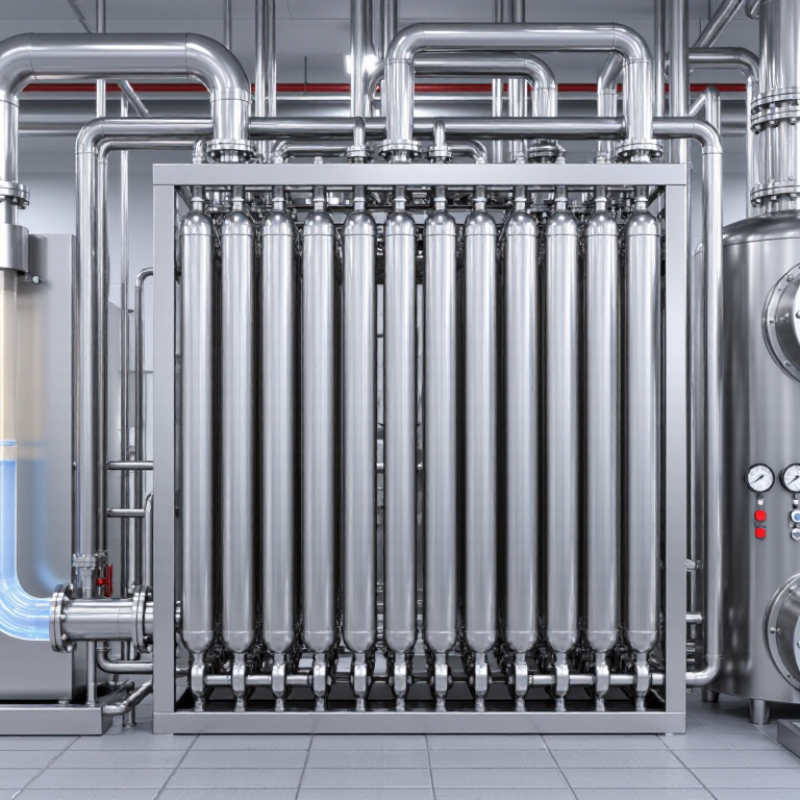
Falling-film evaporator |
Vertical tubes with uniform top distribution and gravity-driven liquid film |
Feed solids from dilute solutions up to approximately 50–65%, depending on viscosity and product behavior |
Dairy concentrates, fruit and vegetable extracts, chemicals, and heat-sensitive liquids |
Short residence time; efficient heat transfer; good performance under vacuum |
Requires reliable feed distribution and careful control at low circulation rates |
| Combined Configuration |
Rising-falling film system |
Rising-film section for initial evaporation followed by falling-film finishing stages |
Often arranged for multi-effect operation and staged concentration |
Products requiring broad turndown, staged concentration, or flexible process control |
Combines strong circulation with short final-stage residence time |
Higher capital cost and more demanding process integration |
| Product Sensitivity |
Heat-sensitive or oxidation-sensitive product |
Falling-film configuration with vacuum operation, short vapor-line routing, and rapid discharge |
Product boiling temperature commonly reduced to approximately 45–75°C under vacuum |
Milk-derived products, juices, extracts, enzymes, and temperature-sensitive solutions |
Reduces thermal exposure and can help preserve color, flavor, and activity |
Needs accurate vacuum control and effective non-condensable removal |
| Product Viscosity |
Low viscosity |
Standard falling-film tubes with moderate tube length and conventional distribution |
Typically below approximately 50–100 mPa·s at the operating concentration |
Water-like solutions, dilute chemicals, and low-solids extracts |
High heat-transfer coefficient and relatively low pumping demand |
Performance can decline rapidly as concentration increases |
| Product Viscosity |
Medium to high viscosity |
Shorter tube sections, wider flow passages, forced circulation, or a plate-type finishing stage |
Approximately 100–1,000+ mPa·s, subject to temperature and solids content |
Concentrated syrups, viscous extracts, polymer solutions, and high-solids food products |
Reduces dry-out risk and improves handling of concentrated liquor |
Higher pumping power; lower heat-transfer rate; stronger fouling tendency |
| Heat-Transfer Surface |
Austenitic stainless steel |
304L stainless steel for non-aggressive aqueous service; 316L for chloride-bearing or mildly corrosive service |
Suitable for many hygienic processes at moderate temperature and pressure |
Food, beverage, pharmaceutical, and general chemical applications |
Good fabricability, cleanability, and corrosion resistance in common service |
Not suitable for every chloride, acid, or high-temperature environment |
| Heat-Transfer Surface |
Nickel-based alloy |
Use only after corrosion review for aggressive acids, alkalis, or chloride environments |
Selected according to chemical concentration, temperature, and chloride level |
Corrosive chemical and specialty process streams |
Improved resistance in selected severe environments |
Higher material and fabrication cost; alloy selection must be chemistry-specific |
| Heat-Transfer Surface |
Titanium or titanium-clad surface |
Consider for seawater, brine, and high-chloride services where stainless steel is unsuitable |
Applicable when chloride corrosion and erosion are major design concerns |
Desalination-related streams, brines, and selected corrosive aqueous duties |
Strong resistance to chloride-induced corrosion in appropriate conditions |
High cost; fabrication, welding, and contamination control are important |
| Tube Geometry |
Long straight tubes |
Vertical tubes with a controlled length-to-diameter ratio and accessible cleaning design |
Common tube lengths are approximately 4–12 m, depending on duty and layout |
Large continuous evaporation duties with stable product properties |
Compact footprint and efficient vapor-liquid contact |
Long tubes can be difficult to clean if distribution or fouling control is poor |
| Tube Geometry |
Shorter tubes or multiple sections |
Use multiple calandria sections when viscosity, fouling, or thermal sensitivity increases |
Individual sections commonly selected to limit residence time and pressure drop |
Concentrating products with changing viscosity or heat-transfer behavior |
Improves controllability and allows staged cleaning or maintenance |
Requires more valves, instrumentation, and interconnecting piping |
| Heating Arrangement |
Single-effect operation |
One steam chest or heating circuit with direct vapor condensation |
Steam economy commonly around 0.8–1.2 kg water evaporated per kg of live steam |
Small capacity, intermittent production, or low initial investment projects |
Simple operation and lower equipment count |
Higher steam consumption per unit of water evaporated |
| Heating Arrangement |
Multiple-effect operation |
Vapor from one effect heats the next effect at a lower pressure |
Two to five effects are commonly considered for continuous process service |
Medium and large evaporation duties with steady production |
Improves steam economy; typical steam economy may reach approximately 1.5–4.0 kg/kg depending on effects and design |
Higher capital cost and more complex pressure balancing |
| Energy Integration |
Mechanical vapor recompression |
Compresses and reuses secondary vapor as the heating medium |
Best evaluated where vapor load is stable and electricity is economically available |
High-throughput plants with strong energy-efficiency targets |
Can substantially reduce live-steam demand and cooling-water load |
Requires compressor, electrical capacity, controls, and reliable vapor quality |
| Feed Distribution |
Gravity distributor or perforated plate |
Use with clean, low-viscosity feeds that have stable flow and low suspended solids |
Distribution quality depends on level, flow rate, and hole or channel design |
Clarified liquids and relatively uniform feed streams |
Simple construction and easy inspection |
May plug or become uneven with fibers, crystals, or suspended solids |
| Feed Distribution |
Spray, nozzle, or specially engineered film distributor |
Use when uniform wetting is critical or the feed has higher viscosity |
Requires stable pressure, flow, and nozzle condition |
Viscous products, high-value liquids, and low-flow operating conditions |
Improves tube wetting and helps reduce dry patches |
Nozzle wear, plugging, and maintenance access must be addressed |
| Cleaning Strategy |
CIP-compatible design |
Full-drain piping, hygienic welds, spray devices, suitable slopes, and validated cleaning circuits |
CIP temperature and chemical concentration must follow product and material compatibility limits |
Food, beverage, dairy, and pharmaceutical processing |
Shortens cleaning downtime and supports hygienic production |
Requires careful dead-leg control and sufficient cleaning flow velocity |
| Fouling Control |
High-circulation or forced-circulation arrangement |
Use recirculation pumps, adequate velocity, and online monitoring of heat-transfer performance |
Design velocity is product-specific; excessive shear must be avoided for sensitive products |
Crystallizing, scaling, or protein-containing liquids |
Improves wetting and can delay localized deposition |
Higher energy use and greater pump maintenance requirements |
| Vacuum System |
Central condenser and vacuum pump system |
Include condensate separation, non-condensable purge, vacuum control, and hygienic sealing where required |
Operating pressure selected from product boiling point, heat source, and thermal limits |
Low-temperature evaporation and heat-sensitive products |
Enables lower boiling temperatures and better product quality control |
Air leakage, foaming, or poor condenser performance can destabilize operation |
| Instrumentation |
Standard process monitoring |
Temperature, pressure, flow, level, density or refractive index, and differential-pressure measurement |
Measurement ranges should cover startup, normal operation, cleaning, and upset conditions |
All continuous evaporator systems |
Supports stable concentration control and early fault detection |
Sensor placement and calibration strongly affect control quality |
| Automation |
Closed-loop concentration control |
Use density, refractive index, conductivity, or solids measurement with steam and feed-flow control |
Control setpoint should remain within the product viscosity and quality limits |
Products requiring consistent final solids content |
Reduces batch-to-batch variation and prevents over-concentration |
Inline sensors require calibration, cleaning, and product-specific validation |
| Mechanical Design |
Removable tube bundle or accessible calandria |
Provide inspection ports, lifting points, isolation valves, and maintenance clearance |
Access requirements depend on tube length, bundle weight, and plant layout |
Plants with frequent inspection or high fouling risk |
Reduces maintenance time and simplifies tube inspection |
Needs additional floor space and structural support |
| Safety and Compliance |
Pressure-rated process equipment |
Design vessels, piping, relief devices, and controls according to the applicable local pressure-equipment requirements |
Rated pressure and temperature must include operating, cleaning, and credible upset conditions |
Steam-heated, vacuum, and pressurized evaporation systems |
Improves personnel safety and supports regulatory compliance |
Certification, inspection, and documentation add project time and cost |
| Selection Priority |
Maximum throughput |
Multi-effect falling-film system with optimized heat-transfer area and vapor separation |
Final capacity must be based on feed flow, solids balance, evaporation load, and operating hours |
Large continuous production lines |
High capacity with efficient use of plant utilities |
May be oversized or uneconomical for variable or seasonal production |
| Selection Priority |
Lowest total operating cost |
Compare steam, electricity, cooling water, cleaning chemicals, labor, maintenance, and downtime |
Use a full lifecycle cost model rather than purchase price alone |
Long-term continuous operation |
Provides a more realistic basis for equipment selection |
Requires reliable utility prices and production assumptions |
| Selection Priority |
Product quality protection |
Vacuum falling-film design with short residence time, low hold-up, and rapid product discharge |
Temperature and residence-time limits should be established from product testing |
Heat-sensitive, color-sensitive, or aroma-sensitive products |
Helps minimize thermal degradation and quality variation |
May require more precise control and higher investment |