
Employment Application Apply
China Best Thin Film Evaporator Manufacturers?
Choosing among China’s best thin film evaporator manufacturers requires more than comparing catalog prices. A reliable supplier should demonstrate process experience, engineering capability, and consistent after-sales support. This matters when processing heat-sensitive oils, solvents, pharmaceuticals, or specialty chemicals. Product quality can change significantly with feed viscosity, residence time, vacuum level, and fouling behavior.
A strong manufacturer should explain how its evaporator handles real operating conditions. Ask for documented case studies, material certificates, test results, and references from comparable industries. Inspect details such as rotor design, scraper clearance, heating-area finish, seal construction, and condenser compatibility. These features directly influence thermal efficiency, product recovery, cleaning time, and maintenance costs.
Factory communication also reveals technical maturity. Engineers should discuss throughput in kilograms per hour, rather than offering vague capacity claims. They should identify limitations and recommend pilot testing when scale-up data remains uncertain. Claims need testing. A laboratory trial can expose foaming, wall buildup, unexpected corrosion, or product degradation before installation.
This guide examines manufacturers through practical and verifiable criteria. It considers equipment design, customization, manufacturing control, certifications, commissioning assistance, and long-term service. No supplier is perfect, and published information may not reveal every weakness. Buyers should therefore request current documentation and confirm performance under their own process conditions. The best choice is not always the lowest quotation. It is the manufacturer that combines transparent engineering, proven applications, responsive support, and dependable equipment performance.
What Is a Thin-Film Evaporator? Film Thickness and <1-Minute Residence Time
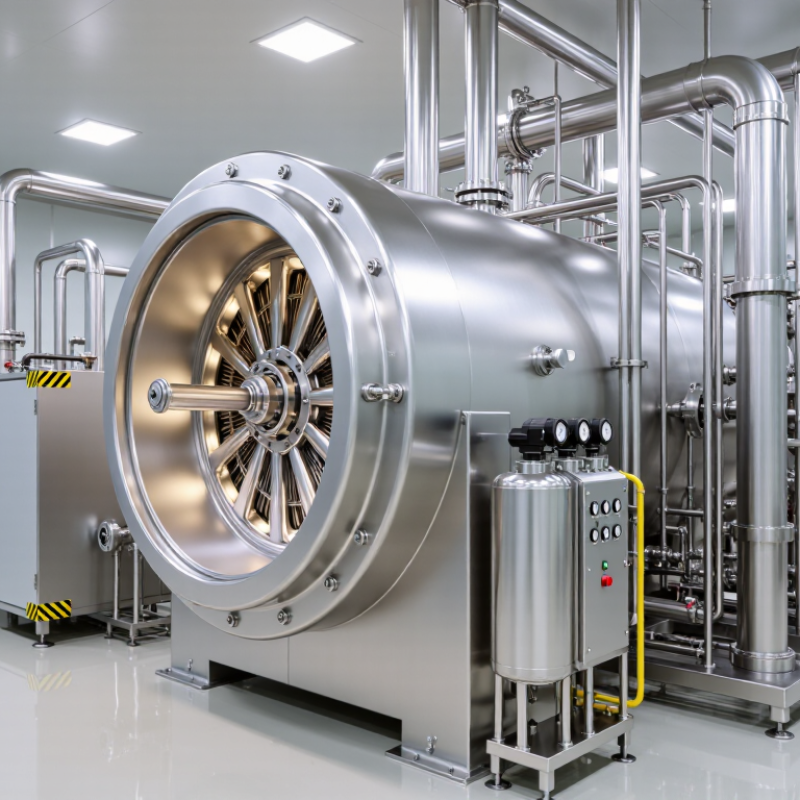
A thin-film evaporator spreads liquid across a heated wall as a very thin, moving layer. A feed enters continuously, while a rotor or wiper system distributes it evenly. Heat then removes volatile components under controlled vacuum conditions. The remaining film may be only fractions of a millimeter thick. This short path improves heat transfer and reduces exposure to high temperatures. Not magic. Design still matters.
Residence time is often below one minute, but it depends on viscosity, feed rate, rotor speed, vacuum level, and wall temperature. A sensitive liquid may leave the heating zone quickly, limiting color change or degradation. Operators should verify this with pilot testing, not rely only on catalog figures. I would record inlet temperature, outlet temperature, pressure, flow rate, and product quality during each trial. Small measurement errors can change the result.
When evaluating thin-film evaporator manufacturers in China, inspect their process data and fabrication records. Ask how they control wall clearance, surface finish, seal performance, and vacuum stability. Stainless steel selection must match the feed and cleaning method. A practical test should use the real material, because water-like samples can hide flow problems. One detail is easy to miss: uneven feeding may create dry spots and unstable evaporation. The equipment may look impressive, yet its performance can remain inconsistent without proper commissioning and operator training.
China Best Thin Film Evaporator Manufacturers? - What Is a Thin-Film Evaporator? Film Thickness and <1-Minute Residence Time
| Evaluation Dimension | Typical Technical Data | Why It Matters | Selection Considerations |
|---|---|---|---|
| Basic operating principle | A thin liquid film flows over a heated cylindrical surface while volatile components evaporate under atmospheric or vacuum conditions. | A large heat-transfer area is exposed to a small liquid inventory, supporting rapid evaporation. | Confirm whether the process requires a wiped-film, agitated-film, or falling-film configuration. |
| Typical liquid-film thickness | Approximately 0.1–5 mm, depending on viscosity, rotor speed, feed rate, surface design, and operating mode. | A thinner film generally reduces internal diffusion distance and improves heat and mass transfer. | The target film must be validated with the actual feed because excessive thinning can reduce wetting stability. |
| Residence time | Often below 1 minute in wiped-film systems; actual values may range from several seconds to several minutes. | Short exposure limits thermal degradation, polymerization, discoloration, and loss of volatile quality components. | Use pilot testing to determine residence time at the required throughput and evaporation duty. |
| Operating pressure | From atmospheric pressure to deep vacuum; many heat-sensitive applications operate roughly between 1 and 100 mbar absolute. | Lower pressure reduces boiling temperature and can protect thermally sensitive materials. | Check vacuum tightness, condenser capacity, non-condensable removal, and pressure-drop limits. |
| Common operating temperature | Typically about 40–250 °C, depending on product properties, pressure, heating medium, and required evaporation rate. | The combination of temperature and pressure determines vaporization intensity and product quality. | Specify both heating-medium temperature and actual product-film temperature. |
| Heat-transfer coefficient | A practical design range is commonly about 300–2,000 W/m²·K, subject to viscosity, wetting, boiling regime, and equipment geometry. | Higher heat-transfer performance can reduce required area and improve evaporation capacity. | Do not compare values without confirming test conditions, fluid properties, and whether fouling resistance is included. |
| Typical evaporation capacity | Laboratory and pilot units may process kilograms per hour, while industrial units can process hundreds to thousands of kilograms per hour. | Capacity depends on evaporation duty, feed concentration, viscosity, heat-transfer area, and allowable product temperature. | Request capacity data based on the actual feed rather than water-only performance. |
| Feed viscosity | Wiped-film equipment can handle higher-viscosity feeds than many conventional evaporators; usable limits are application-specific and may extend from low viscosity to several hundred thousand mPa·s. | Mechanical wiping helps renew the film and maintain movement as viscosity increases. | Provide viscosity at feed, operating temperature, concentration, and final product conditions. |
| Feed solids and concentration | Suitable for dilute solutions, concentrated liquids, slurries, and some paste-like materials, subject to solids size and rheology. | The system can concentrate products while limiting the thermal inventory inside the evaporator. | Evaluate particle size, abrasive content, crystallization tendency, and risk of rotor blockage. |
| Rotor or wiper speed | Common operating speeds range from approximately 50–600 rpm, depending on diameter, rotor design, viscosity, and shear sensitivity. | Speed affects film renewal, wetting, heat transfer, residence time, and mechanical shear. | Use adjustable speed control when processing materials with changing viscosity or shear sensitivity. |
| Heat-transfer surface materials | Common choices include stainless steel grades such as 304 or 316L; nickel alloys, titanium, glass-lined, or coated surfaces may be selected for special corrosion conditions. | Material selection influences corrosion resistance, cleanability, contamination risk, and service life. | Base the selection on chloride level, acids, solvents, temperature, vacuum, and cleaning chemicals. |
| Typical applications | Solvent recovery, purification, concentration of heat-sensitive products, polymer processing, pharmaceutical intermediates, natural extracts, and high-boiling liquids. | Short residence time and vacuum operation are beneficial for products vulnerable to thermal damage. | Confirm product regulations, solvent compatibility, hygienic requirements, and hazardous-area classification. |
| Fouling and cleaning | Film renewal can reduce localized overheating, but scaling, polymer deposition, and sticky residues may still occur. | Fouling lowers heat transfer, increases pressure drop, and may contaminate the product. | Assess clean-in-place capability, removable internals, surface finish, drainage, and cleaning-agent compatibility. |
| Product separation | The evaporator separates vaporized volatile components from a concentrated or bottom product; a downstream condenser is normally required. | Efficient vapor removal supports continuous concentration and solvent recovery. | Specify vapor composition, condensation temperature, non-condensables, and recovery requirements. |
| Key performance verification | Verify throughput, evaporation rate, final concentration, product recovery, residence time, energy use, vacuum level, and product quality. | A technically suitable evaporator must meet both process and product-quality targets. | Require testing with representative feed material before final equipment sizing. |
Note: The values shown are typical engineering ranges for orientation only. Actual performance depends on feed composition, viscosity, boiling behavior, fouling tendency, equipment geometry, operating pressure, and heat-transfer conditions.
Related Posts
-
Top 10 Thin Layer Evaporator Manufacturers Worldwide
-
Top 10 Thin Film Evaporator Manufacturers Worldwide?
-
How to Choose the Best Thin Film Evaporator?
-
How to Choose a VTA Thin Film Evaporator?
-
How to Choose the Best Thin Film Evaporator from China?
-
How to Choose a China Agitated Thin Film Evaporator?